Showing posts with label rebuildable atomizers. Show all posts

Monday, August 24, 2015

What are Drip Tips?

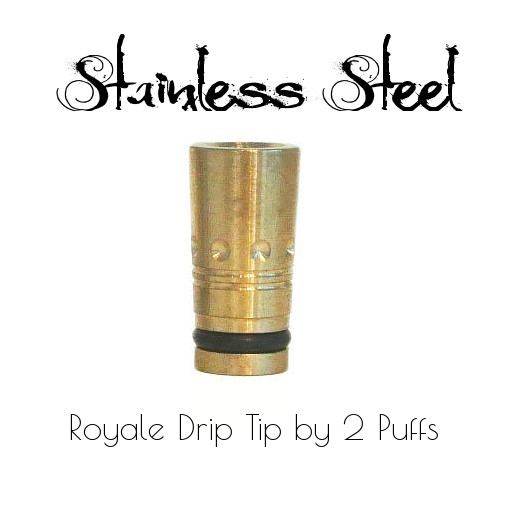
Stainless Steel Royale Drip Tip by 2Puffs
The high-end Royale Drip Tip by 2 Puffs is made of 304 stainless steel and 510 compatible. Image via Vapor Jedi.


A drip tip is more than a mouthpiece for your atomizer. Vapers who are old enough to remember second-generation e-cigs will tell you a drip tip is an ingenuous invention. It cuts the time you spend dripping nicotine juice into your RDA because you don't need to remove the head to insert the dropper into atomizer and coat the coil with your favorite e-liquid.

Drip tips are made of different materials, such as thermal-resistant plastic, hand blown glass, ceramic and stainless steel. Vapers say the material and length of the drip tip will affect the flavor and temperature of each drag.
You will get a different flavour with different tips, Factors affecting flavour include: Tip material, bore size, bore shape, inlet hole size, outlet hole size, tip length, tip weight, tip surface area. Not a comprehensive list but almost all of them seem to affect flavour.
Some people say ceramic and stainless steel drip tips provide the best flavor while others say Pyrex glass is simply the best because it's "almost entirely chemically neutral in a vaping environment."
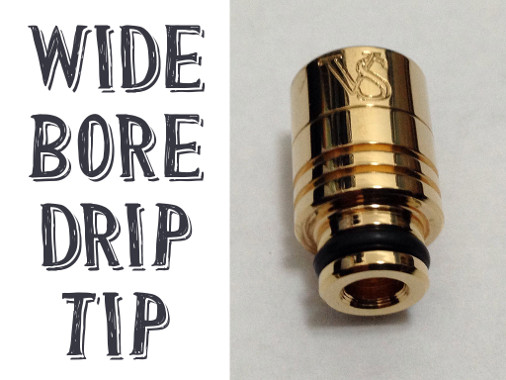
Royal Goblet Drip Tip by Vape Smith Philippines
The Royal Goblet Drip Tip by Vape Smith Philippines is a wide-bore type made of stainless steel. It's made for Castle RDAs and other systems that use 510 connectors. Image via Vapor Jedi.


One of the threads at The Vapers Shed forum mentioned the following materials as neutral tasting: stainless steel (particularly 316 and 304), titanium (surgical grade), brass (naval or marine grade), stone, ceramic, and glass (either Pyrex or Borsilicate). If it's made of glass, the drip tip must be all glass because the flavor may not be neutral if it's on an aluminium holder, for example.

Materials that may affect the flavor of the e-juice to some extent include: aluminium, thermoplastic known as Acetal Homopolymer or by its popular trade name of Delrin, acrylic, several types of wood, and rubber. In some cases, drip tips with Teflon coating end up producing metallic tasting vapes.

The following text from a Vape Ranks article describes the drip tip best:
Also known as a mouth piece, the drip tip comes in various shapes and sizes, and can be made out of different materials, like stainless steel, aluminum, plastic or ceramic. The material from which a drip tip is manufactured as well as its length greatly influences the temperature of the vapor produced by an electronic cigarette. Steel drip tips, for example, cool off the vapor as it passes through it, but long plastic drip tips are also known to deliver cooler vapor, because of the distance it travels to reach the mouth.

Drip tips are best used on rebuildable atomizers. E-cigarettes like the Evod have drip tips, but they're not replaceable. Some drip tips are short while others are long. You preference on the temperature of your vapes will determine whether a short drip tip is perfect for you or not.

Friday, August 7, 2015

A Swift Intro to RBAs, RDAs, RTAs and GRAs

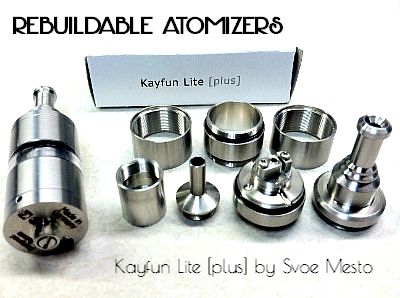
kayfun-lite-plus-by-svoe-mesto-400x298
Kayfun Lite Plus by Svoe Mesto (Photo via Vapor Jedi)


A rebuildable atomizer or RBA is designed to work like a charm even after its components have been dismantled carefully, replaced or modified according to a vaper's specifications, and put back together correctly.

This customizable atty (vape slang for atomizer) is a favorite among sub-ohm vaping fans. It gives them the creative freedom to build a custom coil-and-wick structure that not only looks beautiful in form, but also works really, really well in producing clouds of vapor.

An RBA may be classified into one of three types: RDA, RTA and GRA. These atomizers have different advantages and disadvantages they can offer to vapers.

RDA - Rebuildable Dripping Atomizers

The drip-type atomizer or RDA is the simplest among the three. It doesn't have a built-in (either semi-sealed or sealed) juice container or tank. You build your own coil(s) and wick(s) using a variety of materials, drip e-juice from the bottle onto the wick, and vape away. When the draws start to taste a bit dry and less flavorful, it's time to drip in more juice.

PROS: These atomizers are typified by a short, 510 base that has sufficient space to hold a coil or coils. Liquid nicotine flows from a small juice well on its tip and into the wick via a drip tip. They are frequently used for sub-ohm vaping. They often produce the most flavorful vapes.

Practically, any type of coil is compatible with RDAs. The shape, quantity and resistance values of the coils are limited only by the number of terminal posts you put in and the size of the atomizer's build deck. A wide variety of fibrous materials from all-natural cotton balls to ceramic rods or ropes can be used for the wick.

CONS: Many RDAs don't have a juice container. Even those atomizers with the deepest juice wells can only hold 30 or so drops of e-juice at a time. And so, e-juice from the oversaturated wick has a tendency to leak. This will require you to have an extra e-juice bottle at your disposal.

Great examples are Nimbus, Origen, Magma, Veritas, Tugboat, Plume Veil, 454 and Vulcan. Many RDAs have a "deep juice well" in the drip tip and feature both vertical and horizontal coil designs.

RTA - Rebuildable Tank Atomizers

All RTAs operate on the principle of "pressure differential". In short, the positive pressure in the air venting system and the negative pressure in the liquid tank are kept separate, yet balanced.

PROS: The e-juice is carefully fed to the wick in appropriate quantities until the fibrous material is saturated with liquid. As the wick expands inside the atomizer, it expands and pushes against the mouth of the tank atomizer, and the orifice shrinks in size. The layer between the two opposing pressures acts a sealant that prevents excess e-juice from flowing into the drip tip.

CONS: The coils and wicks in RTAs aren't as easy to replace or modify as those used in dripping atomizers.

Best examples are the SvoeMesto Kayfun3.1/KFL+ and Kebo Russian/R91%. These two have held the top spots in both genuine and clone RTA popularity, with the Taifun GT, sQuape and Fogger V4 and Flash-E Vapor in hot pursuit. New RTAs come out from all around the world every few weeks. The Gus Estia and Inverno Erlkönigin are currently only available in genuine form, but they will become very popular once cloned.

Genesis Rebuildable Atomizers

These RBAs depend on the power of osmosis to pull juice up from its bottom tank. One end of the wick is submerged in the juice inside the tank. Strong capillary action pushes the juice upwards as the wick's absorbent material becomes saturated with liquid from the bottom up.

genesis style tank atomizer
UD AGA-T4 Genesis RBA is a dual-coil genesis-style rebuildable tank atomizer. (Photo via Vapor Jedi)


PROS: These atomizers generally use wicks made from ultra-absorbent materials, such as a stainless steel mesh, a natural fiber rope, and porous ceramic rods. They provide adequate, but not excessive, capillary action.

CONS: The juice tank is not sealed or regulated in any way. So, when the atomizer is tipped to the side or turned over upside-down, some of the juice might leak into the e-cig and wreak havoc on its circuitry, or it could come out of the wick hole or tank vent port. Also, you may need to "tip" the atomizer to get juice up to the portion of the wick that's wrapped by the coil.

Examples of modern genesis-type atomizers are the Smoketech Dual Coil Pyrex RSST, the Mirandus Genesis RBA by Circle of Mod, and the UD AGA-T4 Genesis RBA, which is a dual-coil genesis-style rebuildable tank.